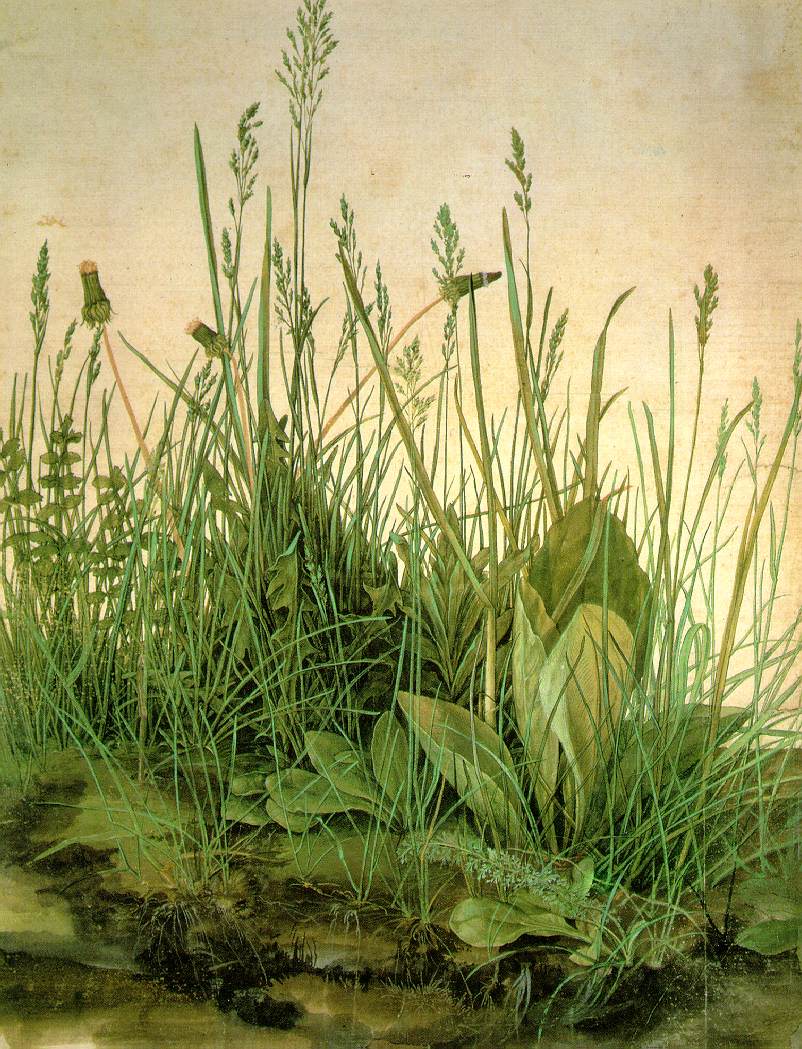
Albrecht Durer’s “The Large Piece of Turf” features a chunk of soil and weeds that could just as easily have been dug up from the vacant lot down the street from me (here in 2012) as from the German meadow that likely inspired Durer hundreds of years ago.
Black Walnut Society Officially Unveiled
Do you garden under a Black Walnut tree? Have you searched the internet seeking lists of species that grow under Black Walnuts only to discover that the lists are sometimes contradictory, or that (even worse) they are waaaaay too short to satisfy your jonesing for plants?
Is your Black Walnut tree interfering with your gardening pleasure, making you irritable, or adversely affecting your overall life enjoyment quotient?
Have you cut down a Black Walnut tree or had thoughts of cutting one down?
Garden Designer’s Roundtable: By the Sweat of Your Brow Will You Weed Your Bed.
My husband and I moved into our house in Burke, VA (Zone 7a) early in 2003 and immediately got to work on “letting the yard go” for about, oh, 4 years or so. I’m sure the neighborhood was horrified by our neglect, as I know you will be when you see the “before” pictures. Continue reading
Do Garden Designers Need To Have Pretty Gardens Themselves?
Next week I will be participating for the first time in the Garden Designer’s Roundtable, a website that features a monthly round-up of blog-posts by garden design professionals. Each month, several of the Roundtable’s designers provide their unique perspectives on a given topic, with links to all the posts published on GDRT. Cool!
BWD Six Months Old Today
I’ve read quite a few “blogoversary” posts lately, or posts where the blogger “takes stock” of his or her blog and announces to readers where the blog is heading. The latter seems kind of funny to me, sort of like evaluating your relationship with a boyfriend and deciding whether or not it’s working for you. (“I will always have feelings for you, Blog, but I just don’t see us being together long term.”) Anyway, since this is me and Blog’s six-month anniversary, I thought I would do my own li’l reflection.
Literary Gardeners: Mayella Ewell and Maudie Atkinson
This weekend my son accompanied me to the garden center and wanted to choose his “very own” little pot of flowers. I let him browse around the annuals section and take his pick. He chose this:
It will look cheerful out on our sunny back patio, but honestly, I cannot look at a red geranium without thinking of one of the most wretched and pathetic characters in all of American literature.
That would be Mayella Violet Ewell.
Remember her? Mayella stars in the novel To Kill a Mockingbird and is the primary witness for the prosecution in the trial of Tom Robinson, the black man whom Mayella and her despicable father falsely accuse of rape.
All through the novel, the Ewells are characterized as the worst kind of “white trash” — dirty, drunken, wretched, illiterate trash. Author Harper Lee describes the yard of the Ewell cabin as “the playhouse of an insane child,” with random car parts, broken tools, and other detritus strewn about. But then there’s this:
“Against the fence, in a line, were six chipped-enamel slop jars holding brilliant red geraniums, cared for as tenderly as if they belonged to Miss Maudie Atkinson…people said they belonged to Mayella Ewell.” Continue reading
How to Leave a Garden Legacy?
We gardened as if we would be there forever, in an immediate pleasure in the moment that seemed to imply an inexhaustible future. Little of what we did there then remains, though the daffodils must, and that thought is very pleasant to us.
Joe Eck and Wayne Winterrowd
Our Life in Gardens
I came across this quote today and I know it is going to be haunting me for days and weeks to come. Only a select few gardens are preserved and maintained after their owners pass on. Since we know our gardens will almost certainly change beyond recognition once we leave them, in what other ways can we leave a garden legacy? Photographs? Diaries? Teaching? Writing? Seed saving?
How do we leave traces of our passion?
This is a picture of my grandfather, who grew wonderful flowers and vegetables in his small urban lot in Detroit. It was taken in July of 1959. He died long before I was born. A few years ago I asked my mother what kinds of flowers he grew. “Hmmm, roses and peonies. Oh and dahlias, I think,” said my mother.
At the time I thought: too bad, those aren’t really my thing.
But in April of this year I found myself curiously, unexpectedly, drawn to roses. In April I planted a bareroot ‘Therese Bugnet’ in my side yard. And I’ve been pausing over the dahlia pages in nursery catalogs.
The garden is a habitat of mighty forces, and I’m not just talking about photosynthesis.
Thomas Rainer Hits It Out of the Park AGAIN.
I’m sure that my readers are but a small, ragtag subset of Grounded Design readers, but if you haven’t read Thomas Rainer’s new post, “Why the Perennial Border Matters“, please do so.
In his post, Thomas presents for our consideration the intricately planted (some would say “fussy”) traditional English perennial border. He compares the study of great perennial borders by the likes of Christopher Lloyd to “training for a triathlon” — in other words, the ultimate planting design challenge.

Long Border at Great Dixter. http://www.hgbgs.org.uk
Now, I’ve never been a big fan of English perennial borders — not because the plantings aren’t magnificent, but because they’re always laid out along a flat, straight axis. Garden paths that resemble I-80 through eastern Nebraska are not really my cup of tea. Perhaps because of my upbringing in the hills and woods of the Piedmont, I prefer a bit of curve or rise or dip in my garden experience, but whatever.
That is not really the point.
What resonates with me about Thomas’ post is his assertion that a great perennial border demands profound plant knowledge from the designer. I love that he is writing about this kind of thing because in my mind it elevates planting design from the way we often see it presented — as a paint-by-numbers exercise — to what it can be, what it should be — high art!
To create a planting masterpiece, it is not enough to be familiar with basic design principles. It’s not even enough to be familiar with bloom time and foliage texture, is it? A great planting designer needs to be familiar with all of the ages and stages of his medium.
This line from his post really gets to the heart of the matter:
“Mixing tulips, for example, among various perennials is incredibly tricky. Their leaves can easily smother newly emerging perennials. But Lloyd and Garrett understood exactly what perennials can co-exist with hundreds of tulips.”
So this is the kind of knowledge that, if applied, can elevate a planting from merely pleasing to downright exquisite. For me, knowing that the foliage of my Deutzia ‘Chardonnay Pearls’ starts to green out around July 4th, or that my Autumn fern turns a glorious tawny orange in the fall but my Southern Wood Fern doesn’t, or that the stems of my Toad Lilies only retain that excellent purple tinge until about June 1st, so that combo with Astilbe ‘Delft Lace’ I was so proud of will only last a few weeks, duh!!– ahem – this is the kind of profound understanding of plants I need to be striving for.
High maintenance? Uh, yeah. But the maintenance is part of the pleasure. Those guys who love vintage cars hardly ever actually drive them, right? They fuss over them, polish them, tinker with them – that’s how they enjoy them. Same with gardeners. We enjoy our gardens by working in them, clipping, digging, yanking, chopping, nipping, stomping — possibly even flinging, weeping, or cursing. Sitting in an Adirondack chair with a lemonade gazing upon the flowers? Yeah, sounds good, maybe I’ll try that one day.
And fussy? I guess an intricate mixed planting with highly choreographed bloom-time that takes into consideration the changing texture, form, color, and culture of each plant in the design could be considered fussy. But then, you could say Renoir’s work was fussy, too. And the poetry of TS Eliot. Martha Graham’s choreography? Shakespeare’s Hamlet? Also fussy.
So thanks, Thomas, for pointing out that “low-maintenance” should not always be the guiding principle of garden design. Thanks for reminding us that this is art we’re talking about.