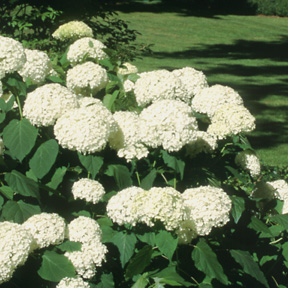
Current Plant Crush: Strawberry Foxglove

I'm still waiting for flowers like this. Maybe next year? http://www.bloomiq.com

Last spring I was re-designing a largish bed in my back yard – it’s sort of a weird bed because one side of it gets decent sun but the other side is pretty shady.  My plan included Fothergilla ‘Blue Shadow’, Deutzia ‘Chardonnay Pearls’, Carex pennsylvanica, Heuchera ‘Dale’s Strain’, and Sarcococca

After planting all of that, I stepped back and realized it was missing something.  I thought it would look cool to have some tall, spiky perennials dotted amongst these groundcovers and shrubs, and I was thinking something in the rose-pink family would do the trick, so I went back to the nursery to do some scouting.

It was then that I stumbled upon Strawberry Foxglove (Digitalis x mertonensis), which I knew nothing about it, but which looked promising.  Instead of going home to do research and see whether or not this plant would truly be a good fit – as a wise and disciplined gardener would do — I purchased five of them on pure impulse. 

At the time of purchase and planting, these foxgloves had no flowers or even buds; only the large, deep green, dimply leaves were present.  I waited patiently for them to show some buds, but it never happened.  Now, I know that the common foxglove, Digitalis purpurea, is a biennial, and that it would be normal for the flowers to emerge in the second year.  Strawberry Foxglove, however, is billed as a true perennial, and so I thought I might get a glimpse of its flowers the first year.

But no.

I will be bummed if these things never flower.  However, I must say that the toughness of their foliage has really impressed me.  During that terrible heatwave in July, when everything else in the garden was looking parched and withered, my Strawberry Foxgloves stayed fresh and green, with very little extra watering.

And even now, in early December, they are cheerful tufts of green among the straw-colored carex.  It looks like I have five big plates of spinach salad sitting in the garden:
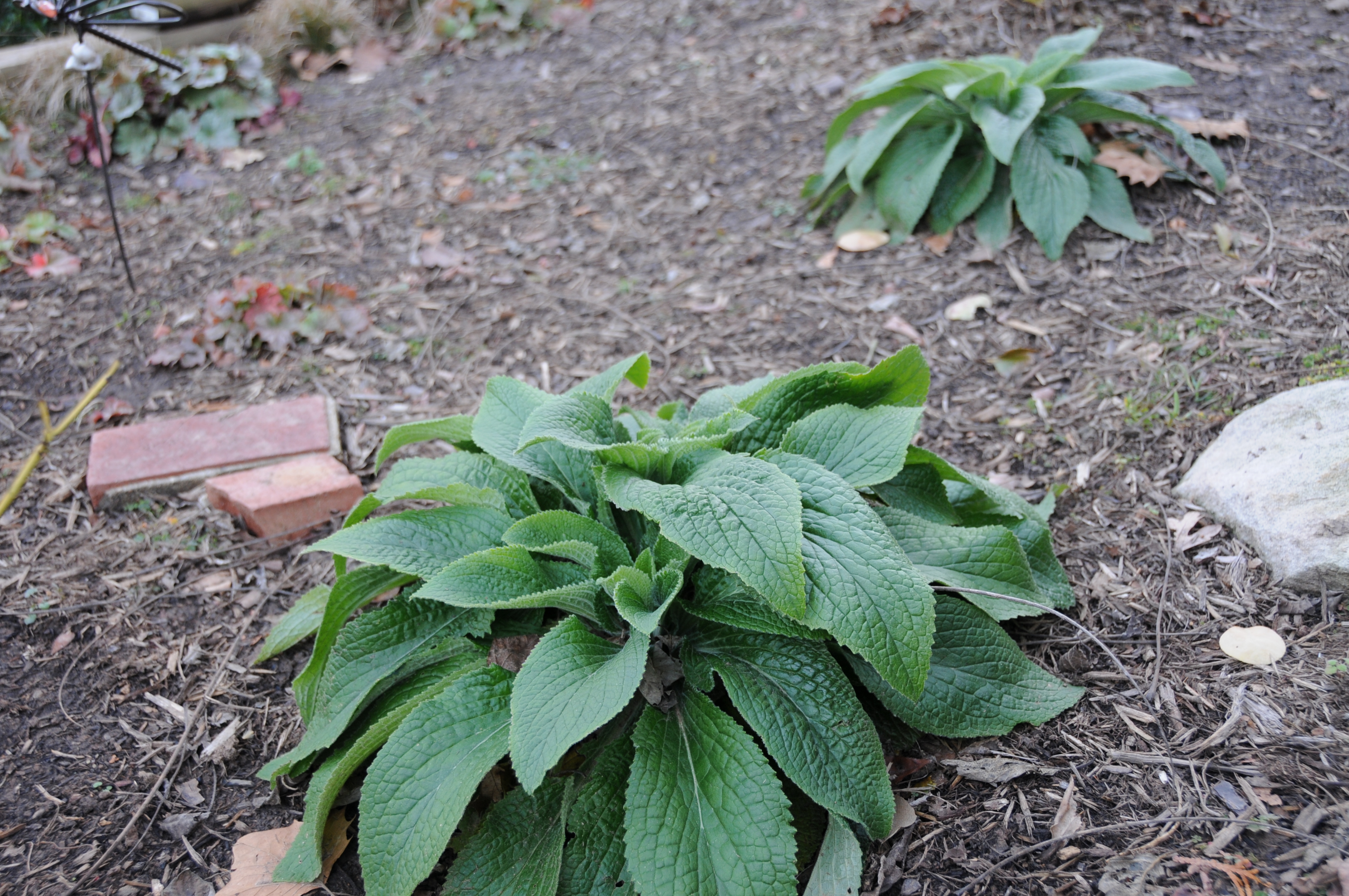
Strawberry Foxglove on December 1. I almost want to drizzle some balsamic dressing on it.

(I should also add that these foxgloves survived being dug up two weeks after planting — inexplicably — by my four-year-old son, who was enjoying an unsupervised and fairly destructive jaunt through the garden — a story best told in a separate post.)

Anyhow, if these things give me flowers next year – fingers crossed! – I will be smitten!
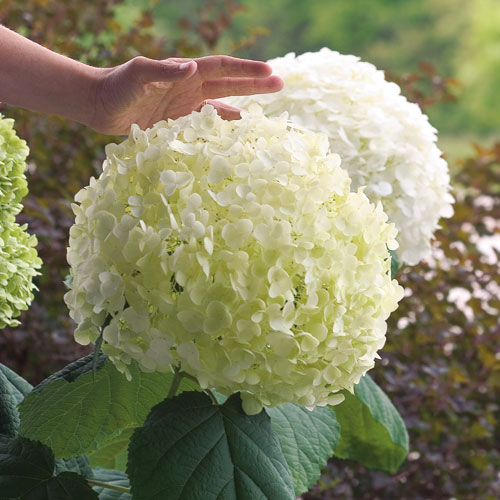
Introducing: Hydrangea x ‘Jenna Jameson’

 
Actually, it’s called ‘Incrediball’, but come on, my name is better. http://www.waysidegardens.com

 Ha-ha.  Just kidding.  Its real name is Hydrangea ‘Incrediball’ and it was on all the catalogue covers a couple of years ago.  I remember seeing it on the cover of the Wayside Gardens catalogue and thinking, are you kidding me???

Now, I’m not a huge fan of the Smooth Hydrangea cultivars in the first place, so this new, freakish cultivar just makes me want to run into a closet and hide.  I like the classic ‘Annabelle’ hydrangeas in certain situations — a neighbor of mine with a Victorian style house has a nice Annabelle growing at the corner of the porch, and it looks dandy there.  Just right.

I know you already know what it looks like, but here’s ‘Annabelle’:

Hydrangea 'Annabelle' http://www.colorchoiceplants.com

It’s hard to imagine a couple of plant breeders standing in front of this shrub going, “yeah Bob, it’s nice and all but something’s missing…I think the flowers are just too darn small.”

In case you’re wondering what ‘Incrediball’s great-great grandmother looked like, here’s a picture:

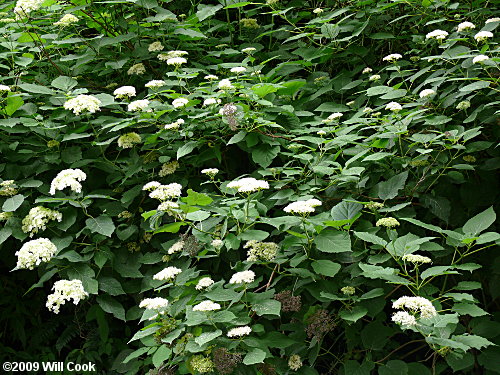
Hydrangea arborescens sp. http://www.duke.edu

She’s a real beauty, eh?  It’s the wild Hydrangea arborescens.  I’m not sure why we feel the need to breed this lovely plant into something bordering on the grotesque.  I guess it goes along with our natural American craving for bigger, better, more.

However, before I get too smug about my good taste, I should say that I looooove those ridiculously huge allium bulbs, like ‘Gladiator’ and ‘Globemaster’:

Let’s face it.  These are giant purple orbs floating above the rest of your plants.  So why are these cool and the ‘Invinciball’ just tacky?


All I Want for Christmas is a $20,000 Dry Stack Stone Retaining Wall

We are lucky enough to have a backyard swimming pool, which is a total blast for our family in the summertime, and which by default becomes the visual center of attention for the whole backyard. Much of my “intensive gardening” takes place around this pool, since I like to make its environs as inviting and floriferous as possible in the summer.  Unfortunately, the pool is surrounded on two sides by nearly 100 linear feet of retaining wall made from those god-awful wooden railroad ties.

A glimpse of the timber wall. The sight of it even makes Max feel morose.

These railroad ties must have been all the rage with builders and landscapers back in the early 80s, because they are ALL OVER my neighborhood, which was constructed at that time.  I suppose they’re okay for some applications, but I really don’t think they should be “featured” in a garden as ours is  in our pool area.  Especially when they begin to rot, as our wall has.  It seems each year a new section of wall either collapses or is gnawed from the inside out by carpenter ants, and we’ve had to replace parts of it three times now.  This year, the corner section is going:

This part is totally deteriorating.

As you can see, I had the clever idea to grow cotoneaster over the wall in order to conceal it, or at least to distract the eye with something more comely.  Unfortunately, the cotoneaster is nearly as hideous as the wall, so that plan didn’t exactly pan out.  This summer, as I observed the timbers in this section of wall gradually decaying like teeth on a corpse, I decided , damn it, I’m going to get some estimates for a stone wall to replace this thing!  Stone…lovely, earthy, beautiful, weatherproof, ant-proof stone…once I began to imagine it, it was hard not to become completely infatuated with the idea of a gorgeous stone wall gracing my backyard.

For several weeks I gazed at images of stone walls on the internet.  I measured my site.  I sketched ideas: the wall would sweep around the pool in a gorgeous S-shaped curve, it would be mostly shades of gray but with some hints of orangy-earth tones to match the color of existing rock already scattered around.  It would be the prettiest wall ever.  It would be the Scarlett Johannsen of walls.

Time to get an estimate.

The first place I called was a local landscape maintenance company that I like.  Their estimate was around eight grand.  Pricey, yeah, but I knew it was probably on the low side.  I think this company would have built a good wall, but the vibe I got was that it wouldn’t necessarily have been an artful wall.  That’s what I want.  Artful. 

So then I called up another contractor I knew.  I became familiar with this contractor during my brief stint working for a local landscape designer in DC, and I knew the company did beautiful work and that they could definitely build an artful  wall.  So one of the guys came out, and he talked to me about what I wanted, and being the geek that I am, I described to him my “dream wall” and I even did a little sketch on his notepad.  And he was very nice, and he said we could go to the stone yard together to hand pick the stone, and he said, “maybe in the future we could consider some low-voltage lighting,” and he wove me a beautiful fantasy about the building of this wall. 

The last thing he said to me was:  “So I’ll call you in a few days with the estimate and we’ll go from there!”  Then he gave me a warm handshake and left me with an array of glossy brochures.

That was four months ago, and he still hasn’t called.

I was stood up by the stone wall guy!

The truth is, I suspect he was waiting for me to call him before he took the time to work up the estimate.  I suspect that, when we met, he glanced around and deduced from the plastic lawn furniture and cheap reed fencing that selling me an exquisite stone wall was probably unlikely.  So he gave me the brush off – sort of like in high school when the guy stops calling the girl once he realizes she’s not going to put out.

But he was right, damn it.  The reason I didn’t call him and ask “hey, where’s my estimate?” is because I’m pretty sure a beautiful stone wall built and installed by this company would set us back at least twenty thousand dollars.  Perhaps much more.  Even if I had that kind of money sitting around, I don’t know if I could bring myself to spend it on a retaining wall.  I have a good dose of thrifty Scottish blood in me which is constantly at war with my shameless and extravagant desire for a beautiful garden.   Twenty thousand for a car, a college education, emergency open-heart surgery – yes.  Twenty thousand for the wall? 

The railroad timbers aren’t THAT bad.

So in the meantime I will be taking suggestions for better plants to spill over my timber wall in order to camouflage it.  And I will be adding this book to my Amazon Wish List:

 It’s not as good as the “dream wall”, but it’s $19,975 cheaper.

Poetry Wednesday: “LL Bean Christmas Catalogue”

One day I will pack up, move into its glossy pages
and take up permanent residence in this snowy tableau: Looking out from the porch of my rustic Maine cabin, protected from the frosty air in my Sherpa Fleece Big Shirt in Dusty Plum, my loving gaze falls upon my chiseled and stunningly coifed mate. He is the perfect man

in his Natural Fit Double L Jeans and Loden Waterfowl Sweater.Color-coordinated yet masculine, he snowshoes back home carrying a tidy bundle of holly berry branches and a Log Cabin Nut Gift Set. This man won’t leave dirty puddles inside the door or scratch his crotch or soil our sink with whiskers. This man will hunt ducks, split logs and set up our Lobster Shack Coastal Birdhouse, but stay as pleasant and fresh as this New England morning.

Our two perfect offspring – donned in Katahdin Outerwear in Azalea and Loden – look up with glee from where they’ve been cheerfully romping with their Kiln-Dried Maple Sled. No dangerous balls of ice beamed at little sister here, no threats or hair-pulling in these pages. Just rosy-faced cooperation in the talcum soft snow. They are, of course, our most prized treasures.

Except perhaps for my Discovery Skis and Rossignol X5 Ski Boots in Loden.

We will come in from the chill and gather ‘round our Classic Farmhouse Table for a cozy winter breakfast.  Bursting with the spirit of the season, we’ll invite that lovely African-American couple from page 73 – for though they appear the picture of outdoor contentment, he seems out of place in his Nordic Cruiser Cross Country Skis and she looks perplexed carrying packages in her Boat and Tote Bag in Trapper.

But heck, it’s nothing a Blueberry Breakfast Gift Set can’t fix.

Our bellies full, we’ll chuckle merrily at the litter of puppies asleep on their monogrammed Biscuit Dog Bed in Loden, and when our neighbor asks “What color is ‘Loden’ anyway?” we shall laugh politely into our mugs of cocoa pretending not to have heard.

That night after sending our darling offspring to their Handcrafted Spindle Beds my mate and I will cozy up together under our Fleece Throw in Periwinkle. There, in the light of the Moonbeam Clock
on the mantle, he will tear off my Pima Cotton Flannel Nightgown in Duck and Laborador Retriever Print — with extra button – and, ….

Afterwards, our hairstyles intact, we will sleep without dreaming while outside more snow falls, collecting in airy layers.  And when my feet get chilly in the dark of night he will turn to me and whisper “my darling, why don’t you slip on your imported Wicked Good Moccasins made from superior sheepskin?”

I have never felt so in love.

-Mary Gray

Semi-Double Indemnity: Hort Noir

image credit: igrayne01

I spotted her pouting face among the pots of generic shrub roses at the local Home Depot.  The sultry red petals, the sassy curves of her stems.  I slipped a hand into her dewy foliage to check the tag: Rosa ‘Dolly Parton’.  Figures.  A hybrid tea.  What was a dame like her doing in a joint like this?

“What’s a dame like you doing in a joint like this?”

She didn’t answer.  A petulant little thing.  But I couldn’t take my eyes off her voluptuous blooms.

“I’ll be you’re a lotta trouble, eh Doll?” I said, taking a closer look.  Yup. Already a hint of black spot.  Traces of rust.  And leggy.  Sooo leggy.

I should’ve just walked away.  Yeah, I knew better.  But a hybrid tea like her doesn’t just drop into your life everyday, not with giant corollas like that.

The dame was coming home with me.

Thanks to the poet Charles Goodrich and Garden Rant for introducing me to this genre. 

TOP TEN MOST FEARSOME GARDENING TOOLS

Blogging for Dummies tells me that readers love Top 10 Lists.  So here goes.

After doing a bit of insta-research, I discovered a list of the TOP TEN MOST DANGEROUS GARDEN TOOLS.  This information was gleaned (er, copied) from a UK website posted by the Royal Society for the Prevention of Accidents. I couldn’t find a comparable list for the US, but I figure American gardeners are victims of the same kinds of gardening accidents as our friends across the pond:

 1. Lawnmowers

I guess this one’s no surprise, though I don’t really know if I’d consider a lawnmower a “gardening tool”.  Anyway, they are scary, that’s for sure.  When most of us imagine a lawnmower mishap, blood and dismemberment are the first things to come to mind, but lawnmowers can harm you in other ways, too.  Stones and debris flung toward the eyes at high velocity, engines that get hot enough to cause first degree burns, and then there’s the the noxious fumes. 

This summer my next-door neighbor nearly died of lawnmower-induced carbon monoxide poisoning.  He was mowing his grass when an afternoon rain shower sprung up, and he took refuge in his shed to wait it out – with his running lawnmower.  It only took a couple of minutes in the cramped space for him to succumb to the fumes and he passed out.  Luckily his wife found him, but he was in the hospital for five days. 

Don’t screw around with lawnmowers.

2. Flowerpots

This one had me scratching my head at first.  How can a flowerpot hurt you?  Are people in the UK doing something unusual with their flowerpots, like hurling them at their neighbors?  But then I realized, oh yeah, big containers weigh a ton, people are lifting them up and moving them around by themselves (like I was yesterday) instead of finding somebody to help them like they really should, only there’s nobody around to help and you don’t want to go ask your spouse or your kids because then you’ll have to track dirt into the house and they’ll roll their eyes and groan because you’re interrupting their TV show to go out and help move a stupid pot.  Anyway, it’s really hard on your back.  I’m sure the injuries are things like torn muscles, slipped discs, and the like.

3. Secateurs and pruners

The word secateurs just sounds dangerous.  Maybe because it’s French and reminds me of words like guillotine.  It sounds like something the Three Musketeers definitely would have carried around with them.  

4. Spades

When digging holes, don’t look up to admire a bluebird on a distant tree branch while plunging the spade down.  Especially don’t do this while wearing flip-flops. 

5. Electric hedgetrimmers

My electric hedge trimmer has a safety feature whereby letting go of the trimmer shuts the motor off.  This is a good feature for me since the trimmer is fairly heavy and my arms start to ache after about 15 minutes of using it, so there is always the danger of suddenly dropping it.  Honestly, I don’t find many situations where the electric hedge trimmer is easier to use than regular hedge-clipping shears.

6. Plant tubs and troughs

See #2 — Flowerpots

7. Shears

I actually think shears are safer than pruners since they require two hands on the handles while in use.  This reduces the chances of pruning your own thumb off, as I nearly did a couple of years ago. 

 8. Garden forks

See #4

9. Hoses and sprinklers

I don’t get this one.  Tripping on a hose is all I can think of.  Are people peering down the ends of their hoses, wondering why they’re not working, and then getting blasted in the eye with a gush of water, like in a Tom and Jerry cartoon?  I don’t own a sprinkler so I’m not familiar with the dangers they pose. I suppose barefooted children frolicking in the spray could be at risk. Frolicking children are always at risk, it seems.

10. Garden canes and sticks

Again, this was a UK study, so I’m not familiar with “garden canes” and “sticks.”  Probably they’re stakes and supports of various kinds. They sound so quaint and Beatrix Potter-ish, but in a fearsome way: “And then, Farmer McGregor picked up his garden cane and started to swing it furiously at Peter Rabbit’s head.”  Anyway, try not to skewer yourself on these while tying up your tomatoes.

Plant-Driven Design and My Garden Manifesto!

“The single most important element in any garden is not some particular object, plant, or tool.  What’s vital is a gardener who loves it.”  — Scott and Lauren Springer Ogden, Plant Driven Design

One of the reasons that garden design fascinates me is because of the push and pull between those two words: garden and design.  Put another way:  which is more important in gardenmaking – aesthetics or experience?  In Plant-Driven Design (perhaps my all-time favorite design book), Scott and Lauren Springer Ogden argue firmly in favor of experience over aesthetics when it comes to garden design.

Now, you could argue that being immersed in an exquisitely designed space is an experience.  Of course it is.  I’ve never visited the gardens of Versailles, but I have no doubt that it would be unforgettable, that its elegance, opulence, and vast scale would evoke a powerful emotional response, just as Louis and Le Notre intended.

But that’s not the kind of experience I’m talking about.  Nor is it the kind of experience sought by the Ogdens in their design practice.  Gardens are not only about pleasing the eye.  They are not simply “outdoor spaces” in which architecture reigns supreme and plants are used merely as flourish, or worse, as “material” by which to achieve architectural goals. They are adamant in their distaste for “landscape installations,” and the fact that the garden has been reduced to “a product, a home-improvement project, a look.”

In an Ogden garden — and in the gardens I hope to design — the plants run the show.  They are unequivocal in their belief that gardens should not simply be designed spaces, but rather places where people connect with plants. This is obvious when you flip through the book and see gardens bursting with a diversity of luscious plants, all carefully and lovingly chosen according to the conditions and spirit of the site.

It follows then, that the experience derived from a garden should really be an intimate one.  It should involve all the senses and involve them across time.  Buds should be examined, flowers sniffed, leaves crushed between the fingers in summer and in fall admired as colorful filters of sunlight.  Spring’s cool mud and summer’s baked clay should both be felt with the hands.  Death should be witnessed and accepted.

Obviously, this is not the experience Le Notre was trying to create at Versailles.  As the Ogdens put it, this is about “unlimited possibilities for reconnection with the natural world.”

Actually, what we’re talking about here is a relationship – a serious, long-term relationship.  The problem for the garden designer is that many clients do not necessarily seek this kind of relationship with their gardens.  Clients often want something “attractive but low-maintenance.”  In other words, they want a Stepford wife that looks pretty, serves up cocktails, and never throws them a challenge.  As a result, they wind up with a hardscape/cherrylaurel-based design that may be pleasant enough to look at but which will never touch the soul.

This is not acceptable.

Like the Ogdens, I believe that gardens should touch our souls through sensory experience with plants.  I know that there are different definitions of gardens out there, but I’ve adopted this one and I hope other homeowners and designers will consider adopting it, too.

The poet Gary Snyder said: “Nature is not a place to visit; it is home.”   Snyder may not have been trying to express a new paradigm for how we Americans should envision our gardens, but I think this quote expresses it perfectly.

The missing ingredients? Love and attention.

Most of us, when we buy a house, are given the gift of a quarter acre of soil and sunshine. (Or a half, or a tenth – size isn’t the point.)  Many of us don’t see our little patches of dirt as “nature,” but our lots are as “natural” as the local park, the fragment of forest at the end of the block, the meadow we admire on our favorite local hike.  Our yards are, collectively, the nature that is left, the nature we experience every day.  We should honor our little patches with our time, sweat, and creativity, not just design them as pleasant places to grill burgers.

You and Your (Non-Gardening) Spouse

"Looking good, Honey. Don't stay up on that ladder for too long pruning or your beer will get flat."

Does your spouse share your passion for worm composting, Felco products, and beneficial nematodes?  In the winter, do you pore over seed catalogues together into the wee hours?  Spend happy weekends together pruning, weeding, and watering?  Does your spouse understand the depth of your grief when your Camellia – that rare cultivar you found at a specialty nursery, the one with the double pink flowers that were exactly like the ones on the wallpaper you had in your room when you were little – when it succumbs to verticillium wilt and dies a slow, shriveling death – does he embrace you and whisper reassurances in your ear?

No, mine doesn’t either. 

My husband Dan is a non-gardener.  He prefers an indoor lifestyle for the most part; his outdoor activities are limited to: swimming, reading in the hammock, and coming out onto the porch when I’m gardening to ask me where something is.   

Once, I asked him if he could name three plant families and he said yes, he could. 

“Flowers, bushes, and weeds” he said.

Just today, when Dan came across some pumpkin seeds our son had saved, he asked if there was a seed that could grow pumpkin pies.  “Now THAT would be some gardening I’d be interested in!”  he says.  Ha-ha.

Sometimes I am jealous of those couples who share the gardening bug.   I used to watch a bunch of the gardening shows on HGTV: P. Allen Smith, Gardening By the Yard, Landscaper’s Challenge, etc.  My favorite show was one called Gardener’s Diary.  In  each episode the hostess would visit a different garden – often a private garden created by an enthusiastic amateur, or sometimes, one tended by a couple who were both passionate gardeners. 

One image from such an episode sticks in my mind: there was a voice-over of the wife talking about how the garden has “brought Chad and I together” (I don’t remember if his name was really Chad) and then there was an image of Chad giving his wife a piggy-back ride through a beautiful meadow garden on their property – a meadow that they had undoubtedly created and nurtured together, through mutual cooperation and team spirit.

Why doesn’t Dan give me piggy-back rides through our garden

It’s a troubling thought.  I mean, why can’t we be this couple:

"We also put in each other contact lenses and we steer the car together!" http://www.glamour.com

Oh well.  I have to confess, there are some advantages to being the sole gardener in the family.  Namely this:  the garden is my own little kingdom where I get to make all the decisions.  That probably sounds very control freak-ish of me, but I have to admit it’s true.  Since so much of marriage is about compromise and sacrifice, it’s nice to have a little realm to myself where my spouse doesn’t really have a clue about what is going on.

This summer Dan was walking out to the shed to retrieve a piece of pool equipment, when he noticed something.

         “How did this tree get here?”

         “Oh that?  I planted it.”

         “When?”

         “Hmmm…in April, I think.  Yes,  April 2007.”

         “Really?”

         “Yup.  I think there’s some tuna in the fridge.   Why don’t you go and make yourself   some lunch?”

I watched his retreating form, and then I turned back to my work, fishtail weeder in hand.  I dropped down to my knees and started tugging at the oxalis growing between the irises.  Queen of the Kingdom.  Er, Queendom.