Hasta la Vista, Crappy Old Deck

You know you’re a parent when spring “break” is busier and more stressful than being at work.  Having a five-year-old boinging around the house all day CAN be fun, but also makes it hard to squeeze in even a short blog piece, let alone something longer and thoughtfully composed.

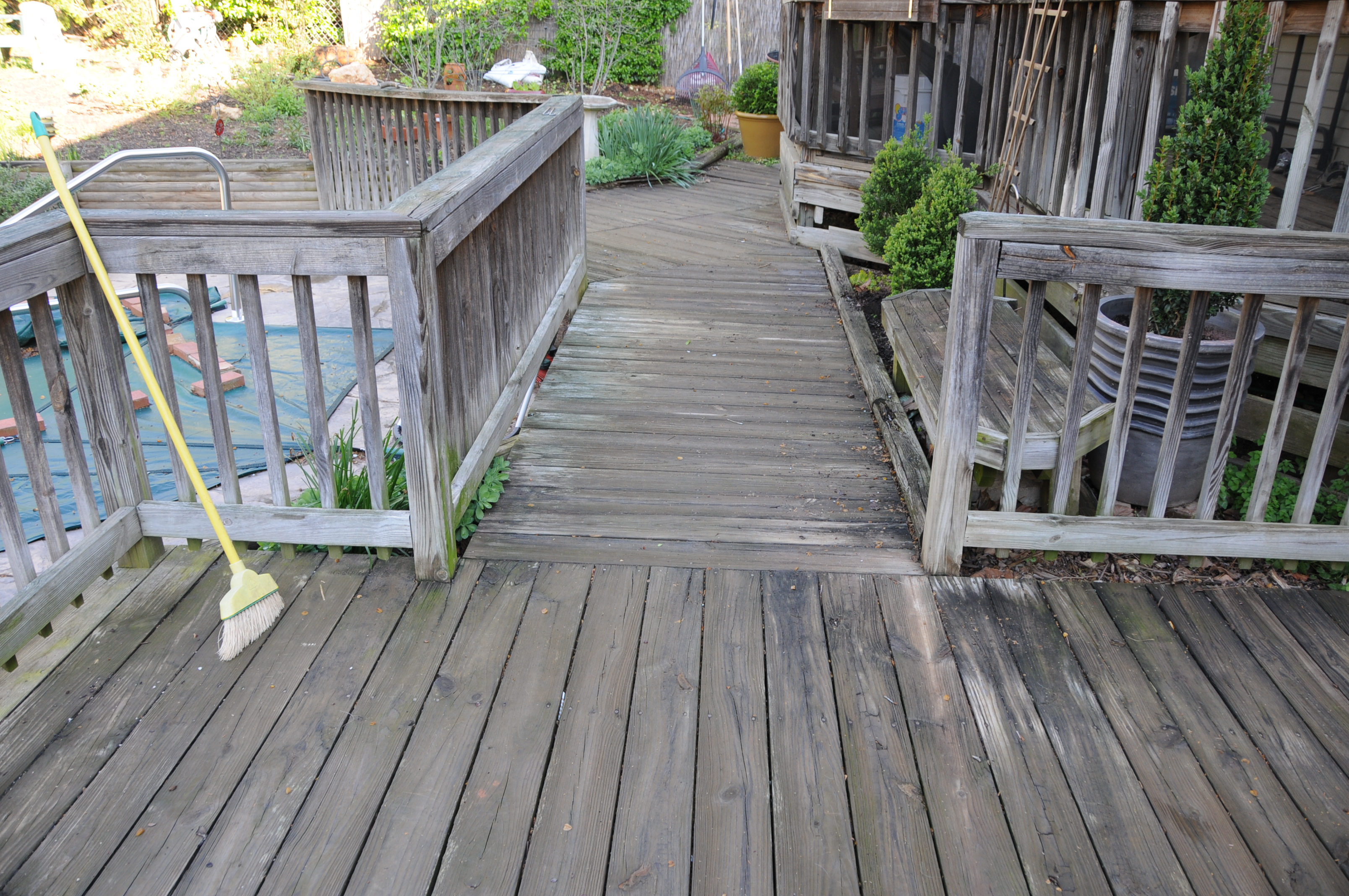
So this li’l update will have to suffice.  In addition to being busy with my son, I’ve also been pre-occupied with watching my 30-year-old deck get ripped out.  Whoo-hoo!  Here’s a couple of before pictures:

Continue reading

What Can Gardeners Learn from Grizzly Man?

“Human place in nature”  is a topic I’m semi-obsessed with right now, and though it seems sorta esoteric, I think the issue has huge implications for gardeners and designers.

Here’s what got me all stirred up this time.

I just finished showing the 2005 film Grizzly Man to my English classes as part of a unit on documentary film.  For those of you who haven’t seen it, it’s the story of the life and death of Timothy Treadwell, a self-proclaimed “kind warrior” who lived with the Grizzly bears in Katmai, Alaska for 13 summers in order to study and protect them.

Grizzly Man Theatrical Release Poster

Although Treadwell had a genuine love for animals and appeared to have better relationships with the bears than with other humans, he was actually killed and eaten by a Grizzly in October 2003.

Treadwell’s violent and somewhat ironic death is part of what makes the film fascinating, as is the question of whether he was a courageous hero or a lunatic narcissist.  But as I was watching the film with my classes this week, I was more intrigued by something else. 

The director of the film, Werner Herzog, clearly felt that Treadwell was — if not a lunatic — at least a misguided idealist. Though he might have had some sympathy for Treadwell, Herzog did not share the “kind warrior’s” warm fuzzy feelings about the natural world.  In his narration of the film, Herzog makes some bone-chilling statements about nature — statements that are in direct opposition to Timothy Treadwell’s romantic view of wilderness.  After a segment of the film in which a male grizzly kills a cub, Herzog reflects:

“I believe the common denominator of the universe is not harmony, but chaos, hostility, and murder.”

When Treadwell looked into the eyes of a Grizzly, he saw a kindred spirit, a friend, a brother.  Herzog saw no such thing, just “the overwhelming indifference of nature.”

Continue reading

High Art and Italian Sausages at Philly

This groovy wave thing was at the center of a million square feet of contrived awesomeness! http://www.uwishunu.com

Susan Cohan’s recent post about the difference between “Flower Shows” and “Home and Garden Shows” started some rusty gears turning in my brain.  Apparently, some folks argue that the Philadelphia Flower Show is too artificial for their taste, that the floral displays are outrageously impractical, self-consciously artsy, mere theater. 

The heck you say???

Continue reading

A Garden Rubric For You

Well, pretty soon Garden Open Days will be arriving all over the country.   Are you prepared?  I personally feel the Open Days are a little too friendly and casual.  I think we, the garden visitors, need to step it up a notch and that’s why I’ve prepared this powerful critiquing tool that you can bring with you to each garden. 

Putting together this Garden Rubric was a breeze thanks to my 14 years’ experience in Professional Education, where I spend hours each day picking apart the creative work of others!  Oh, but I must give a nod to P. Allen Smith, who supplied the categories I used for the rubric: Color, Abundance, Whimsy, Mystery, Enclosure, and Time (from his 12 Principles of Design).  Thanks, P. Allen!

So print out this rubric and bring it along on your next garden visit!  Along with a red pen and a judgmental  spirit, of course!

gardenrubric

How Are Landscape Designers Perceived?

Wish I could take credit for this one.  Julia Kriz — designer at Landscape Projects, Inc. in Bethesda , MD, and a former classmate of mine at GW — created this nifty visual to illustrate how Landscape Designers are perceived by others:

Continue reading

Top Five Ludicrous Outdoor Bedrooms

In the spirit of Valentine’s Day, HGTV thinks it would be super-romantic if you and your honey set up a luxurious bed out in the backyard so the two of you can giggle under the cherry blossoms and then sleep under the stars! 

Dreamy picture, eh?

But here’s what will happen if you try this at your house, with your actual partner: 

*Your mattress will acquire permanent mud-stains from being dragged through the thawing spring garden.

*As you are gazing at the robin’s egg blue sky, an actual robin will crap on your forehead.

*The sound of your next-door neighbor’s leafblower will seriously compromise the quality of your al fresco lovemaking.


The Nation’s Most Ironic Nature Refuge and The Trouble With Wilderness

Irony is a concept I struggle to teach to my students.  They sort of get it when I give them the classic example of a firehouse burning down.  Or when I present Alanis Morrisette’s song “Ironic” as an example of irony, since as we all know the song lyrics do not describe irony at all.

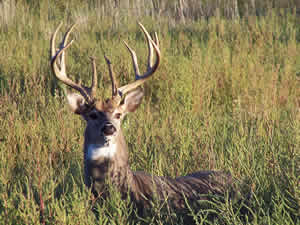
A buck at the Arsenal Refuge. Photo Credit: Aaron Rinker, USFWS

Now I have a new example I can give them: The Rocky Mountain Arsenal Wildlife Preserve.  This nature preserve, near Denver, Colorado, is built upon millions of tons of toxic chemicals.  During World War II, the US Army developed both incendiary and chemical weapons at the site, and later, Shell Oil moved in and used the facility to develop highly toxic pesticides.  Although the government and Shell undertook a massive clean-up operation back in the 1980’s, the site remained too toxic for any kind of intensive human use, like parkland or housing development.  So people stayed away.

But wildlife moved in.

Today, bald eagles roost in the tree tops, elk and deer forage in the woodlands, and ponds and streams teem with fish.  The refuge is home to one of the most successful short-grass prairie restoration projects in the country.

Continue reading

Lessons From the Winter Garden (of My Discontent)

A winter vignette from Mary's garden! Featuring: mud, dead leaves, old bags of planting mix, cheap hoses, rusty stakes, and disillusioned pets.

Ahhhhh yes, the garden in winter.  So serene.  So magical.  So frosty and twinkly!

That is, if you live in the pages of one of those “Winter Gardening” books or articles, which always include the following photos:

1. a cardinal sitting on a snow covered holly branch
2. a close-up shot of a berry cluster, possibly glazed with ice
3. some evergreen boughs adorned with fairy lights, once again with a fine dusting of snow

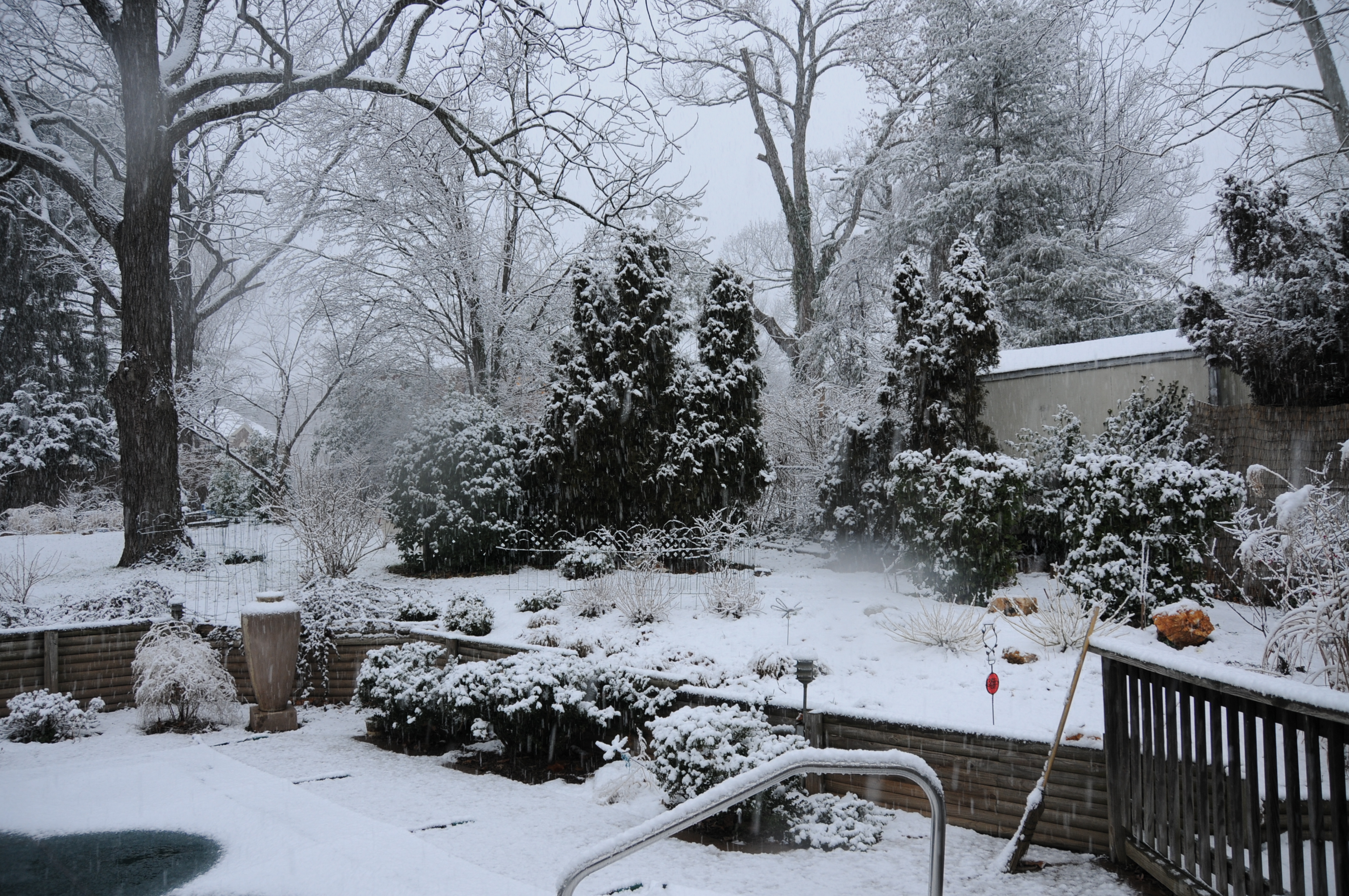
Okay, fine.  I know that winter gardens can be beautiful, but let’s be real.  This thing where there’s a half inch of fluffy snow highlighting the fine tracery of tree branches and creating a Currier and Ives wonderland is waaaaaay overrepresented in the gardening literature.  How often does it snow like that?  Where I live in Virginia, I can count on such a scene for maybe six to ten hours each winter.  Here’s a shot of a lovely, light snowfall from earlier this winter:

I think it made my backyard look rather nice.  On the other hand, it made the landscaping down at the local Shell station look like a friggin’ landscape design masterpiece, so I don’t really think it’s fair to critique winter landscaping under these conditions.  Plus, by 3pm it was all melted and I was left with my more typical winter landscape in shades of brown, tan, greenish-brown, tannish-brown, brownish-olive-green, doo-doo brown, and “mud” brown.  And all of it squishy.

Unless you are gardening in Camelot — where it snows an inch a day, melts overnight, and then snows again in the morning — your garden will not be graced with a fine dusting of fresh snow all that often.  So what to do?  How to design for winter?

Well, I’ve been mulling this over, and today I wandered around my backyard asking myself that very question.  Here are a few thoughts I had during my stroll…things I’m going to keep in mind for the future:

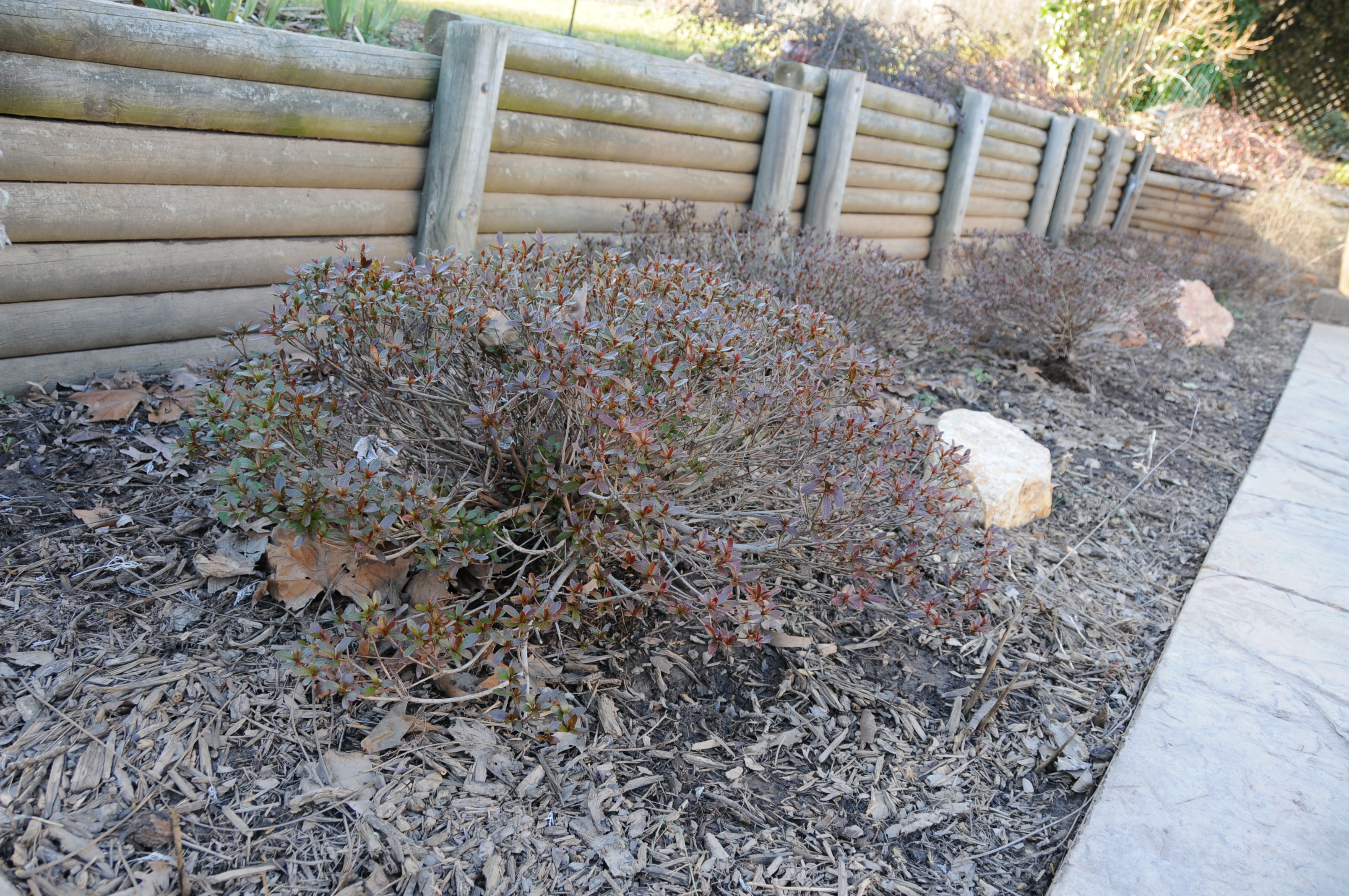
#1 Consider the winter color of evergreens.  Because there’s a good chance it won’t be green.  Many evergreens, like these ‘Macrantha’ azaleas in the photo below, turn a sort of muted plum color in the winter.  This is a characteristic that could be used to your advantage if you can find other plants to contrast or complement this plum color (bergenia?carex? any other ideas?)  In my planting, though, they fade right into the brown of the dirt around them and the timber wall behind them.  So the whole advantage of being evergreen is sort of lost.

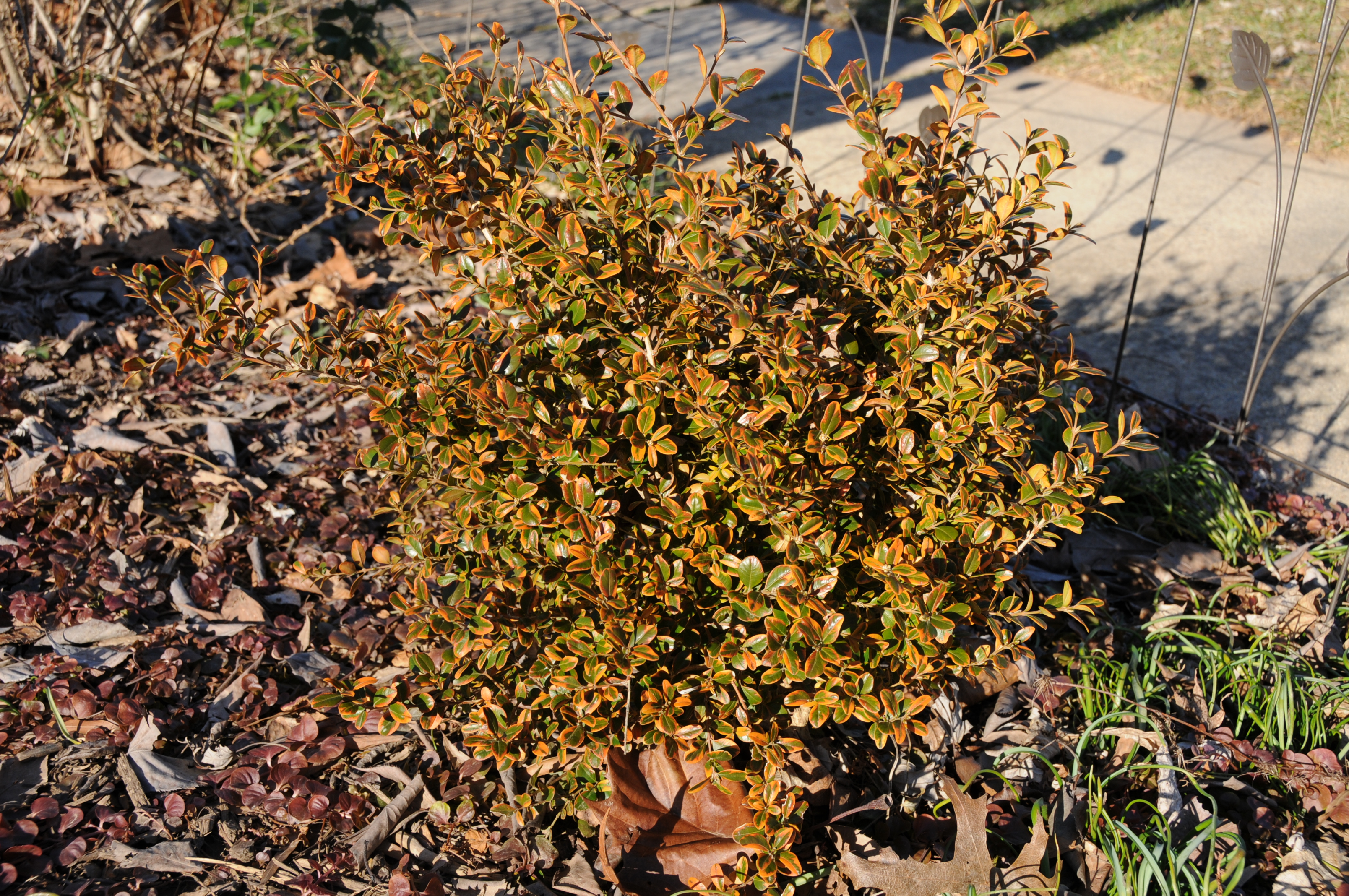
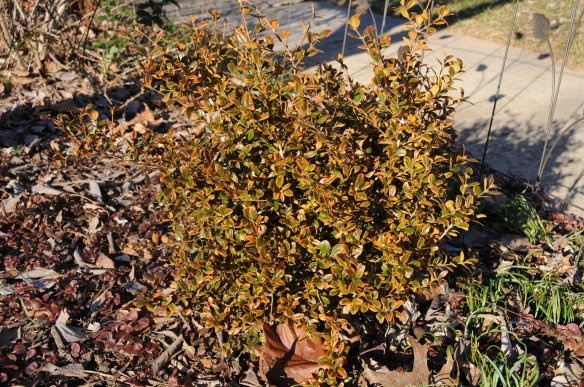
Another example: the variegation on this dwarf boxwood in the photo below changes from yellow to rusty-orange in winter.  How cool is that?  I am dying to pair something with this shrub to make a winter combo extraordinaire…I just haven’t figured out what yet.  Would you hate me if I planted orange pansies around it?
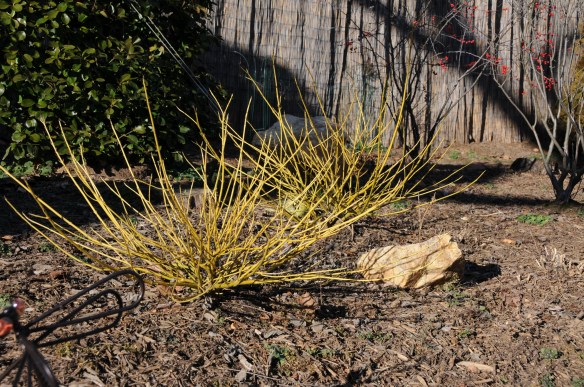
#2 Colorful Stems = Best Horticultural Invention Ever  Last spring I planted three Yellowtwig Dogwoods (cultivar “Green and Gold”) and I could not be more fond of them.  If I’m feeling morose, I make a point of looking out my kitchen window at them and they cheer me right up.  Now…as much as I love colorful stems, I don’t know if I would plant a shrub if that were its ONLY worthwhile attribute.  But this cultivar looks cute in summer, too…not too big and unkempt like other shrub dogwoods, nifty green and white variegated foliage…yup, it’s definitely pulling its weight in the garden.
#3 Berries Rule!  If they are not too eagerly consumed or used as projectiles!  As you can see in the photo above, I’ve got a few Winterberry Hollies  in this garden, and they are looking pretty sad and sparse at this point.  Earlier in fall, they were loaded with berries and totally looking stellar next to a glorious clump of  tawny Miscanthus.  But the birds really do seem to like these berries, which is reason enough to plant them.  Plus, certain five year olds can’t seem to keep their little fingers from plucking them off and either a) hurling them at imaginary foes, accompanied by exploding noises or b) stomping them into a pulp on the wooden deck.  But I guess this is all part of the winter garden experience.

#4 Plant perennials that die with dignity.  My favorite pictures of winter gardens are not the ones with the dustings of snow, but rather the ones that feature large masses of perennials and grasses that remain standing through the cold months in all their brittle, straw-and-russet-colored glory.  What’s missing from my winter garden is the texture, color, and sheer mass that exists in such plantings.  I’ve just got too much empty space. 
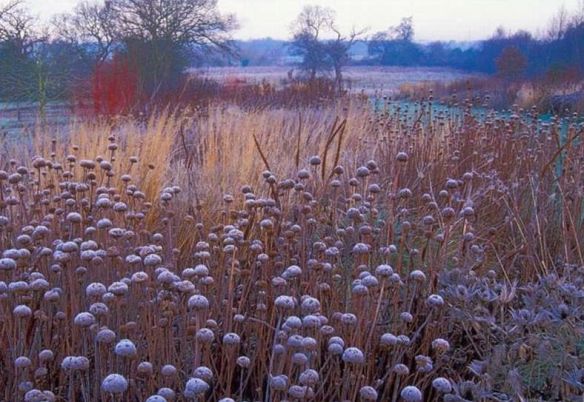
The legendary Piet Oudolf has left me, and probably millions of other winter gardeners, striving for this ideal. It looks so easy but it is truly the work of a genius. Photo credit: Piet Oudolf.

Some gardeners think that planting evergreens can solve this dilemma; however, too many evergreens make a landscape look monotonous, so the trick is to figure out which herbaceous perennials retain strong stems and/or cool seedheads, and plant more of those.  Many ornamental grasses fit the bill.  Sedums, yeah.  I don’t cut those back.  In the spirit of Piet Oudolf and Oehme/van Sweden, I really want to keep all of my perennials standing through winter, but my garden phlox and my turtlehead?  Oh man, they just have to go.  I can’t bear to let their limp, eviscerated corpses lay strewn about my garden.  Leaving too many gaps, though, becomes a problem.  Does Piet Oudolf leave gaps?  I think not.

#5 Have fun with winter vignettes.  I think it’s a great idea to have a few places in the garden in which plant combinations are created specifically for winter appeal.   When I worked at a garden center one year, I was driving one of those electric carts back to a lot where the surplus plants were stored.  It was late fall, and as I was speeding along, a couple of random plants caught my eye — a Nandina domestica and a red Camellia sasanqua.  The pairing of the red berries and deep red flowers, of lacy and glossy foliage together, was stunning. I slammed on my brakes and just stared at this marvelous combo for several minutes.   It was lush and bold and wintry all at the same time…and no snow necessary!