Slangin’ Delightful Plants

Yesterday afternoon I placed my order with Plant Delights, the nursery down in NC that publishes the best, and most addictive, catalog in all of horticulture. 

My intention was  to buy ONLY a Danae racemosa, with which I was unfamiliar until a local designer introduced me to it a few years ago.  Also called Poet’s Laurel, this small evergreen shrub is said to be “laden with marble-sized reddish-orange berries in fall” according to Tony Avent, owner of Plant Delights, author of its catalog, and “dealer” of delightful plants. 

You have to watch out for Tony.  He might lure you into buying a plant merely through his wry, irreverent, and often provocative descriptions.  For example, Tony introduces Poet’s Laurel with this line: “From Iran and other “axis of evil” countries comes one of our favorite garden plants.”  He closes the blurb with: “Danae was the daughter of King Acrisius of Argos…the dude who became a rock gardener when he was shown Medusa’s head.”

Damn you, Tony.  With your puns AND allusions to Greek mythology how can I NOT buy this plant???

Continue reading

The Nation’s Most Ironic Nature Refuge and The Trouble With Wilderness

Irony is a concept I struggle to teach to my students.  They sort of get it when I give them the classic example of a firehouse burning down.  Or when I present Alanis Morrisette’s song “Ironic” as an example of irony, since as we all know the song lyrics do not describe irony at all.

A buck at the Arsenal Refuge. Photo Credit: Aaron Rinker, USFWS

Now I have a new example I can give them: The Rocky Mountain Arsenal Wildlife Preserve.  This nature preserve, near Denver, Colorado, is built upon millions of tons of toxic chemicals.  During World War II, the US Army developed both incendiary and chemical weapons at the site, and later, Shell Oil moved in and used the facility to develop highly toxic pesticides.  Although the government and Shell undertook a massive clean-up operation back in the 1980’s, the site remained too toxic for any kind of intensive human use, like parkland or housing development.  So people stayed away.

But wildlife moved in.

Today, bald eagles roost in the tree tops, elk and deer forage in the woodlands, and ponds and streams teem with fish.  The refuge is home to one of the most successful short-grass prairie restoration projects in the country.

Continue reading

She Wrote Other Books, Too.

Those who dwell among the beauties and mysteries of the earth are never alone or weary of life.

                                                 — Rachel Carson
                                                     The Sense of Wonder

Annie Dillard and the Polyphemus Moth

The Polyphemus Moth http://www.cirrusimage.com

A couple of weeks ago I re-read Annie Dillard’s story of the Polyphemus moth in Pilgrim at Tinker Creek  This little story also appears in Dillard’s An American Childhood, and  it is a beautiful and gut-wrenching bit of memoir.  Dillard has said that this encounter with the Polyphemus moth when she was a young child changed her life. 

 I can understand why.  Even though it’s easy to interpret the episode as pure metaphor (the pain of being unable to “spread one’s wings” I suppose) I think the story is more potent when read literally.  Whenever I read it, I think of young children, those moments when they truly perceive the nature of suffering for the first time, and how devastating those moments can be.  Here is the story:
 
“The mason jar sat on the teacher’s desk; the big moth emerged inside it. The moth had clawed a hole in its hot cocoon and crawled out, as if agonizingly, over the course of an hour, one leg at a time; we children watched around the desk, transfixed. After it emerged, the wet, mashed thing turned around walking on the green jar’s bottom, then painstakingly climbed the twig with which the jar was furnished.

Blogging English Major Nerds

To follow up my last post, in which I lamented the loss of a favorite childhood tree, I wanted to share  a couple of other great posts that center on the Saying Good-bye theme .

First, Dan Verner, author of  Biscuit City, deconstructs that saccharine pop-song-that-you-say-you-hate-but-you-really-love —  “Another Old Lang Syne” — but he does so in the form of a Unit Quiz, as only a former English teacher would ever dream of doing.  Brilliantissimo! 

Then, the delightful young writer Miriam Hodgkins has a fantastic post on her blog Gomad Nomad,  in which she says good-bye to her dreadlocks after three years.  It’s wonderfully written, and if you are considering growing dreads (Mr. Verner, you know you’ve thought about it) this is a must-read!  Miriam has also just come home from an insanely adventure-filled jaunt around the world, and she’s done some stellar writing about her travels.

Continue reading

Plant-Driven Design and My Garden Manifesto!

“The single most important element in any garden is not some particular object, plant, or tool.  What’s vital is a gardener who loves it.”  — Scott and Lauren Springer Ogden, Plant Driven Design

One of the reasons that garden design fascinates me is because of the push and pull between those two words: garden and design.  Put another way:  which is more important in gardenmaking – aesthetics or experience?  In Plant-Driven Design (perhaps my all-time favorite design book), Scott and Lauren Springer Ogden argue firmly in favor of experience over aesthetics when it comes to garden design.

Now, you could argue that being immersed in an exquisitely designed space is an experience.  Of course it is.  I’ve never visited the gardens of Versailles, but I have no doubt that it would be unforgettable, that its elegance, opulence, and vast scale would evoke a powerful emotional response, just as Louis and Le Notre intended.

But that’s not the kind of experience I’m talking about.  Nor is it the kind of experience sought by the Ogdens in their design practice.  Gardens are not only about pleasing the eye.  They are not simply “outdoor spaces” in which architecture reigns supreme and plants are used merely as flourish, or worse, as “material” by which to achieve architectural goals. They are adamant in their distaste for “landscape installations,” and the fact that the garden has been reduced to “a product, a home-improvement project, a look.”

In an Ogden garden — and in the gardens I hope to design — the plants run the show.  They are unequivocal in their belief that gardens should not simply be designed spaces, but rather places where people connect with plants. This is obvious when you flip through the book and see gardens bursting with a diversity of luscious plants, all carefully and lovingly chosen according to the conditions and spirit of the site.

It follows then, that the experience derived from a garden should really be an intimate one.  It should involve all the senses and involve them across time.  Buds should be examined, flowers sniffed, leaves crushed between the fingers in summer and in fall admired as colorful filters of sunlight.  Spring’s cool mud and summer’s baked clay should both be felt with the hands.  Death should be witnessed and accepted.

Obviously, this is not the experience Le Notre was trying to create at Versailles.  As the Ogdens put it, this is about “unlimited possibilities for reconnection with the natural world.”

Actually, what we’re talking about here is a relationship – a serious, long-term relationship.  The problem for the garden designer is that many clients do not necessarily seek this kind of relationship with their gardens.  Clients often want something “attractive but low-maintenance.”  In other words, they want a Stepford wife that looks pretty, serves up cocktails, and never throws them a challenge.  As a result, they wind up with a hardscape/cherrylaurel-based design that may be pleasant enough to look at but which will never touch the soul.

This is not acceptable.

Like the Ogdens, I believe that gardens should touch our souls through sensory experience with plants.  I know that there are different definitions of gardens out there, but I’ve adopted this one and I hope other homeowners and designers will consider adopting it, too.

The poet Gary Snyder said: “Nature is not a place to visit; it is home.”   Snyder may not have been trying to express a new paradigm for how we Americans should envision our gardens, but I think this quote expresses it perfectly.

The missing ingredients? Love and attention.

Most of us, when we buy a house, are given the gift of a quarter acre of soil and sunshine. (Or a half, or a tenth – size isn’t the point.)  Many of us don’t see our little patches of dirt as “nature,” but our lots are as “natural” as the local park, the fragment of forest at the end of the block, the meadow we admire on our favorite local hike.  Our yards are, collectively, the nature that is left, the nature we experience every day.  We should honor our little patches with our time, sweat, and creativity, not just design them as pleasant places to grill burgers.

Andy Goldsworthy — Designs On and Of the Earth

Andy Goldsworthy first appeared on my radar when I was studying Landscape Design at GW (more on that in another post).  I believe that one of my instructors devoted a few slides to him during a presentation on contemporary landscape design, and although Goldsworthy’s work looked intriguing, I never really investigated him further.

Well, yesterday I stayed up too late watching the film Rivers and Tides, a riveting documentary about Goldsworthy from 2001.  And now I am kind of obsessed with the guy.

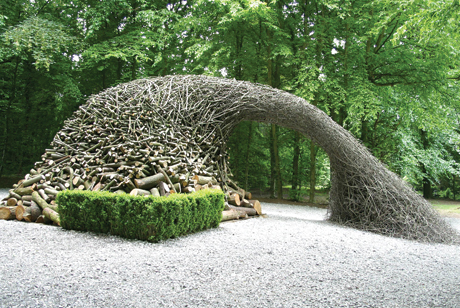
I’m not exactly sure how to characterize what Goldsworthy does.  He’s not a landscape designer in the traditional sense, though he designs on (and with) the land more ingeniously than anybody I’ve seen.  I think most often he’s classified as a sculptor but that title is inadequate.  Judging from the film, Goldsworthy uses only natural materials – usually things he finds right at the site at which he’s working – and his creations are often intentionally transient: a sculpture built from icicles that will melt by noon, an egg-shaped cairn that disappears when the tide comes in, a stunning ribbon of colored leaves that disperses with a gust of wind.

If you were only to watch the interview portions of the film without seeing at him work, you might think Goldsworthy was a bit of a flake who perhaps did too much acid in the 60’s.  He speaks of such things as the earth’s “internal energy” and “geological memories” and you might start to roll your eyes and expect him to pull out his collection of Jerry Garcia memorabilia, but then he shows you something like this:

or this:

or – my personal favorite – this stone wall (at the Storm King art center in New York):

and then you realize that he’s not flaky at all but a total genius. 

I guess that’s one of the problems for a visual artist – whether he’s a painter, garden designer, or sculptor: trying to verbalize emotions and ideas that can only be fully expressed through paint, or flowers, or stone. 

Anyway, Rivers and Tides does an outstanding job presenting the work of Andy Goldsworthy through the medium of film.  If you have any interest in nature, design, landscape, sculpture, or artistic geniuses, you’ll love it.  But a word of caution.  After watching it you may feel compelled to go outside in your backyard and start doodling around with leaves and twigs, when you really should be inside getting the dishes done.