The Nation’s Most Ironic Nature Refuge and The Trouble With Wilderness

Irony is a concept I struggle to teach to my students.  They sort of get it when I give them the classic example of a firehouse burning down.  Or when I present Alanis Morrisette’s song “Ironic” as an example of irony, since as we all know the song lyrics do not describe irony at all.

A buck at the Arsenal Refuge. Photo Credit: Aaron Rinker, USFWS

Now I have a new example I can give them: The Rocky Mountain Arsenal Wildlife Preserve.  This nature preserve, near Denver, Colorado, is built upon millions of tons of toxic chemicals.  During World War II, the US Army developed both incendiary and chemical weapons at the site, and later, Shell Oil moved in and used the facility to develop highly toxic pesticides.  Although the government and Shell undertook a massive clean-up operation back in the 1980’s, the site remained too toxic for any kind of intensive human use, like parkland or housing development.  So people stayed away.

But wildlife moved in.

Today, bald eagles roost in the tree tops, elk and deer forage in the woodlands, and ponds and streams teem with fish.  The refuge is home to one of the most successful short-grass prairie restoration projects in the country.

Continue reading

Gardens and Language — What’s the Missing Link?

Garden sculpture at Little Sparta, designed by Ian Hamilton Finlay

I’m always fascinated by the ways that garden design intersects with other art forms.  The connection between gardens and painting is obvious and intuitive, and has a long history in garden design.  After all, English landscape “improvers” like Capability Brown were really attempting to create idealized landscapes common in paintings by the likes of Poussin and Lorraine. Continue reading

Hospital Healing Gardens Closed in Winter! Booooo!

2012: I have to say that so far, I’m not a fan.

Only three weeks in and there’ve been several deaths and unfortunate diagnoses among our circle of friends and relations.  Then, on Wednesday evening, the Health Scare Fairy paid a visit to the Gray household, a 12 hour stay in the Emergency Room was endured, and two days of tests were performed in the INOVA Fairfax Health Labyrinth.

Continue reading

When the Sun Goes Down Color Disappears

It’s a pleasure to discover beautiful little gems hidden in unexpected places.  I think gardeners are especially adept at this –we notice the rustle of wind through winter grass, the pattern of frost on a leaf, the first crocus pushing through the snow .  These tiny delights of the natural world are not lost on us.

If you pay attention, you can find such gems in books, too — even when they’re not intentional.  A few years ago, when I was taking my first landscape design class at GWU and trying to practice drawing, I came across an intriguing discussion of color in Betty Edwards’ classic Drawing on the Right Side of the Brain.  Color is certainly a fundamental aspect of garden design, and of art in general, but I had never really thought about color in the way that Edwards’ presented it.  Word-Nerd that I am, I decided to turn the passage into a “Found Poem” — which I hereby present for your enjoyment, or possibly your amused pity.  A scan of the original text follows.

When the Sun Goes Down Color Disappears

And what is
 
                                color?

Is it merely — as scientists tell us —

               a subjective experience

                                                               a mental sensation

that can occur only if there is     

                                                   an observer

                      
                     an object                                         and

        sufficient light

in the narrow band of wavelengths called the

       v   i   s   i   b   l   e   s   p   e   c   t   r   u   m

                    ?

Is the world really                  

                          colorless

only seeming to become full of color again when we turn

                                                      the lights on?

We cannot
know.                 What we do
know   

            is that

             
when the sun goes down                                               

                                                                    color                 

                            disappears

American Holly, American Beech, American Graffiti

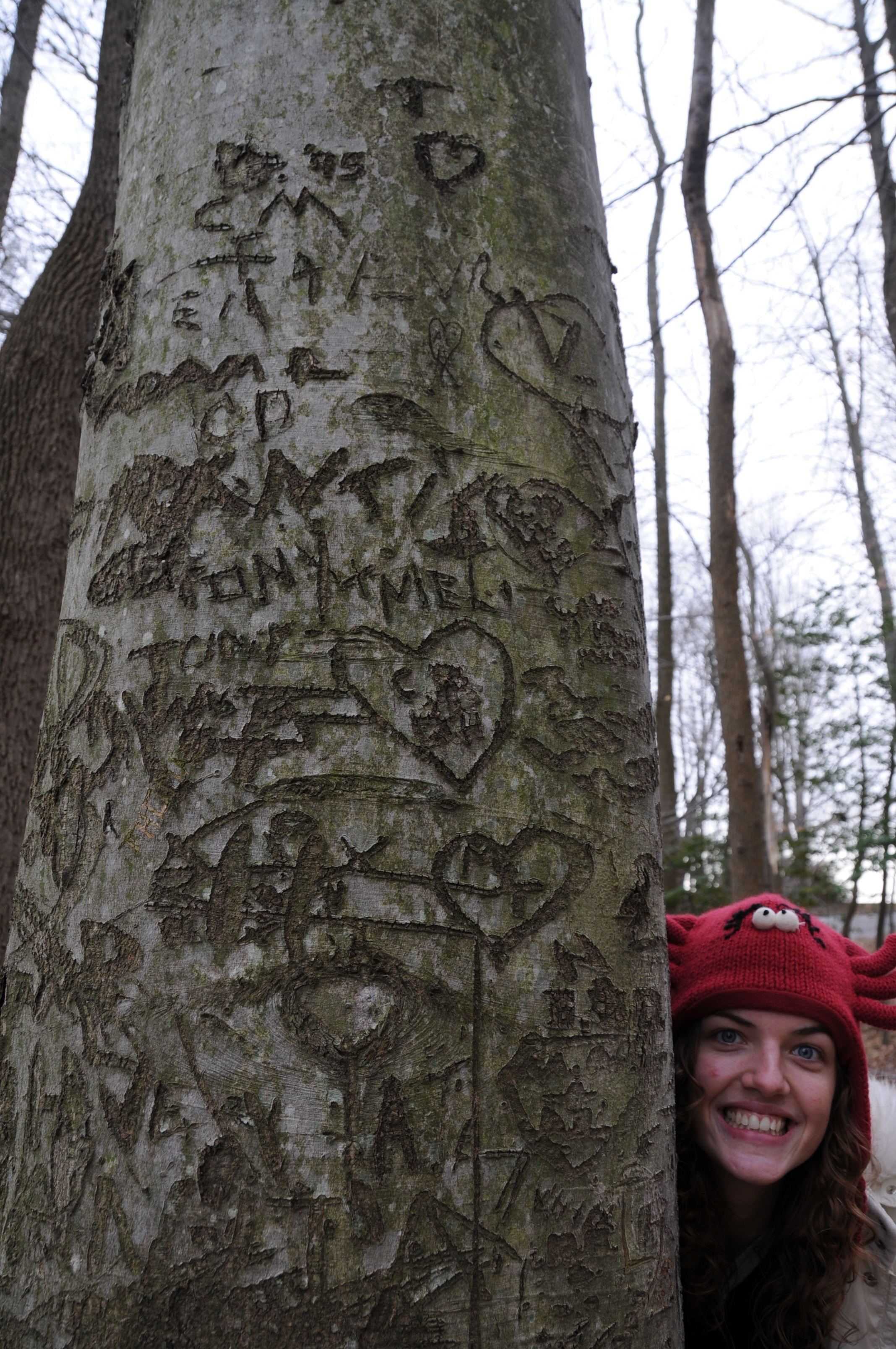
The gorgeous American Beech (Fagus grandifolia) has long been a favorite canvas for young couples in love and other graffiti artists.  My favorite nearby park is filled with beeches, tulip poplars, red oaks, and American hollies.  At this time of year, the beeches call attention to themselves, with their parchment leaves still clinging on, their smooth gray bark, and of course — on many of them — hearts and initials adorning the bottom six feet of trunk. 

F. grandifolia, a favorite tree, along with one of my favorite H. sapiens


Better Homes and Gardens Than Yours

If you’re like me, you are drawn to the glossy pages of gardening and design magazines such as Garden Design, Fine Gardening, etc.   The old classics Southern Living and BHG always feature a residential garden or two in each issue as well.  In case you hadn’t noticed, the gardens pictured in these magazines are beautiful, and you could learn a thing or two from studying them.

For example, look out your window right now.  Is the view you see resplendent with old world charm?  Is it a sublime vision that synthesizes classical European design elements with exotic tropical plants?  Let me ask you something.  Where is your recessed open-air dining loggia?  Your series of outdoor rooms? DO YOU AT LEAST HAVE A FOOTED URN??

That’s okay.  If you look at the homeowners in these pictures, clearly they are more gifted and attractive than you and your family.  Just take a look at their cute little son, dressed all in white and playing a game of croquet on the lawn.  He’s so clean you could eat lunch off of his head.  Now look at your son in his juice-stained Elmo t-shirt.  Looks like he wandered outside without his pants again and is spitting at the birdfeeder. 

You’d better put your magazine down and go get him.

You and Your (Non-Gardening) Spouse

"Looking good, Honey. Don't stay up on that ladder for too long pruning or your beer will get flat."

Does your spouse share your passion for worm composting, Felco products, and beneficial nematodes?  In the winter, do you pore over seed catalogues together into the wee hours?  Spend happy weekends together pruning, weeding, and watering?  Does your spouse understand the depth of your grief when your Camellia – that rare cultivar you found at a specialty nursery, the one with the double pink flowers that were exactly like the ones on the wallpaper you had in your room when you were little – when it succumbs to verticillium wilt and dies a slow, shriveling death – does he embrace you and whisper reassurances in your ear?

No, mine doesn’t either. 

My husband Dan is a non-gardener.  He prefers an indoor lifestyle for the most part; his outdoor activities are limited to: swimming, reading in the hammock, and coming out onto the porch when I’m gardening to ask me where something is.   

Once, I asked him if he could name three plant families and he said yes, he could. 

“Flowers, bushes, and weeds” he said.

Just today, when Dan came across some pumpkin seeds our son had saved, he asked if there was a seed that could grow pumpkin pies.  “Now THAT would be some gardening I’d be interested in!”  he says.  Ha-ha.

Sometimes I am jealous of those couples who share the gardening bug.   I used to watch a bunch of the gardening shows on HGTV: P. Allen Smith, Gardening By the Yard, Landscaper’s Challenge, etc.  My favorite show was one called Gardener’s Diary.  In  each episode the hostess would visit a different garden – often a private garden created by an enthusiastic amateur, or sometimes, one tended by a couple who were both passionate gardeners. 

One image from such an episode sticks in my mind: there was a voice-over of the wife talking about how the garden has “brought Chad and I together” (I don’t remember if his name was really Chad) and then there was an image of Chad giving his wife a piggy-back ride through a beautiful meadow garden on their property – a meadow that they had undoubtedly created and nurtured together, through mutual cooperation and team spirit.

Why doesn’t Dan give me piggy-back rides through our garden

It’s a troubling thought.  I mean, why can’t we be this couple:

"We also put in each other contact lenses and we steer the car together!" http://www.glamour.com

Oh well.  I have to confess, there are some advantages to being the sole gardener in the family.  Namely this:  the garden is my own little kingdom where I get to make all the decisions.  That probably sounds very control freak-ish of me, but I have to admit it’s true.  Since so much of marriage is about compromise and sacrifice, it’s nice to have a little realm to myself where my spouse doesn’t really have a clue about what is going on.

This summer Dan was walking out to the shed to retrieve a piece of pool equipment, when he noticed something.

         “How did this tree get here?”

         “Oh that?  I planted it.”

         “When?”

         “Hmmm…in April, I think.  Yes,  April 2007.”

         “Really?”

         “Yup.  I think there’s some tuna in the fridge.   Why don’t you go and make yourself   some lunch?”

I watched his retreating form, and then I turned back to my work, fishtail weeder in hand.  I dropped down to my knees and started tugging at the oxalis growing between the irises.  Queen of the Kingdom.  Er, Queendom.